
The honest truth about hashtags in 2026.
Hashtags are not dead. But if you are still pasting 30 of them under every Reel, you are working against yourself.
tldr; everything you need to know
Get the platform news that matters.
Hashtags change fast. Coffey Talk is our occasional email for tourism and hospitality brands: what moved on the platforms, what it means for your bookings, and what to do next. Free, and you can unsubscribe any time.
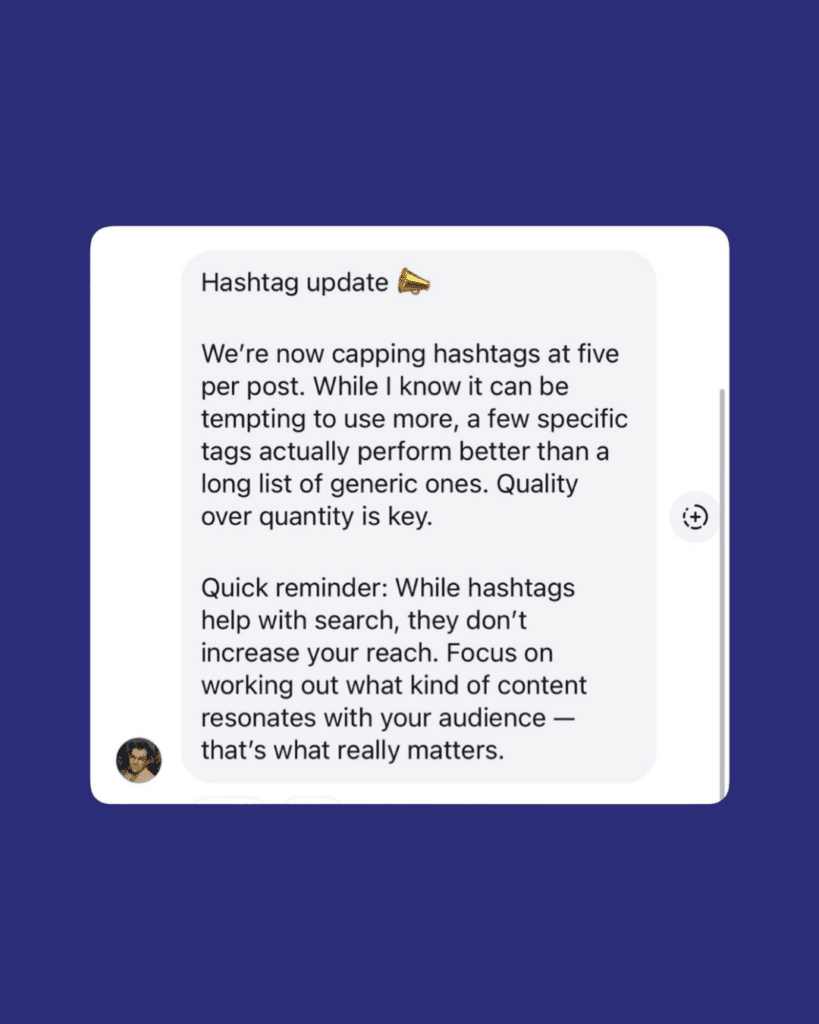
Here’s the headline: in December 2025, Instagram started capping hashtags at five per post. Not 30. Not 10 to 20. Five. In its own words, “using fewer (up to 5) more targeted hashtags, rather than many generic ones, can improve both your content’s performance and people’s experience on Instagram.”
🗣️ “Using fewer (up to 5) more targeted hashtags, rather than many generic ones, can improve both your content’s performance and people’s experience on Instagram.” (Instagram @creators, December 2025)
That is the biggest structural change to hashtag strategy since Reels launched. Everything that follows is built around it.
What’s actually changed with hashtags
A few years ago, more hashtags meant more reach. That logic is dead and buried.
Instagram now reads your content directly: the words in your caption, the on-screen text in your video, the audio, how people interact with it. The algorithm categorises your post without needing 25 hashtags to figure out what it’s about. Hashtags have moved into a supporting role. They add context and reinforce the signal. They don’t drive reach on their own.
There’s also a more commercial reason this matters for tourism brands: social media is now a primary search tool. People research destinations, restaurants, and experiences on Instagram and TikTok before they ever open Google. That means the right hashtags, used correctly, still put you in front of people who are actively planning travel. It’s just a much more targeted game now.
The other big shift: Instagram now indexes the actual words in your captions for search. Someone searching “wine region Western Australia” can find your post even without a matching hashtag. Your caption copy matters just as much as your tag choices.
The formula has changed from:
Use 30 hashtags → hope the algorithm notices
To:
Write a strong, keyword-rich caption + use 3 to 5 targeted tags that confirm what the content is about
The travel hashtag formula for 2026
With a maximum of five hashtags, every tag needs to earn its place. The layered approach still holds, but you have to be ruthless about what makes the cut.
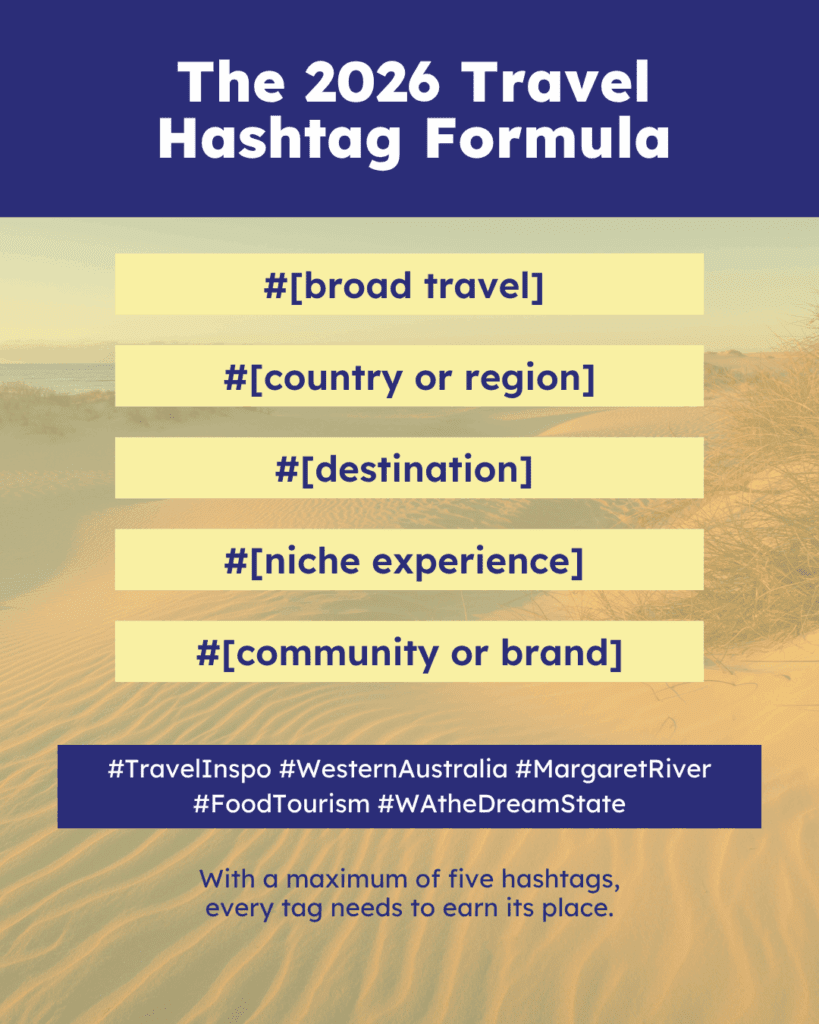
#[broad travel] + #[country or region] + #[destination] + #[niche experience] + #[community or brand]
💡 Example for a Margaret River food and wine experience: #travel #westernaustralia #margaretriver #foodtourism #WAtheDreamState
That’s five. Each one does a different job. None of them are padding.
The one broad tag worth including
With only five slots, you probably only want one broad travel tag per post. These are still worth using as a category signal, but they do the least work. Pick the one that’s most accurate to your content.
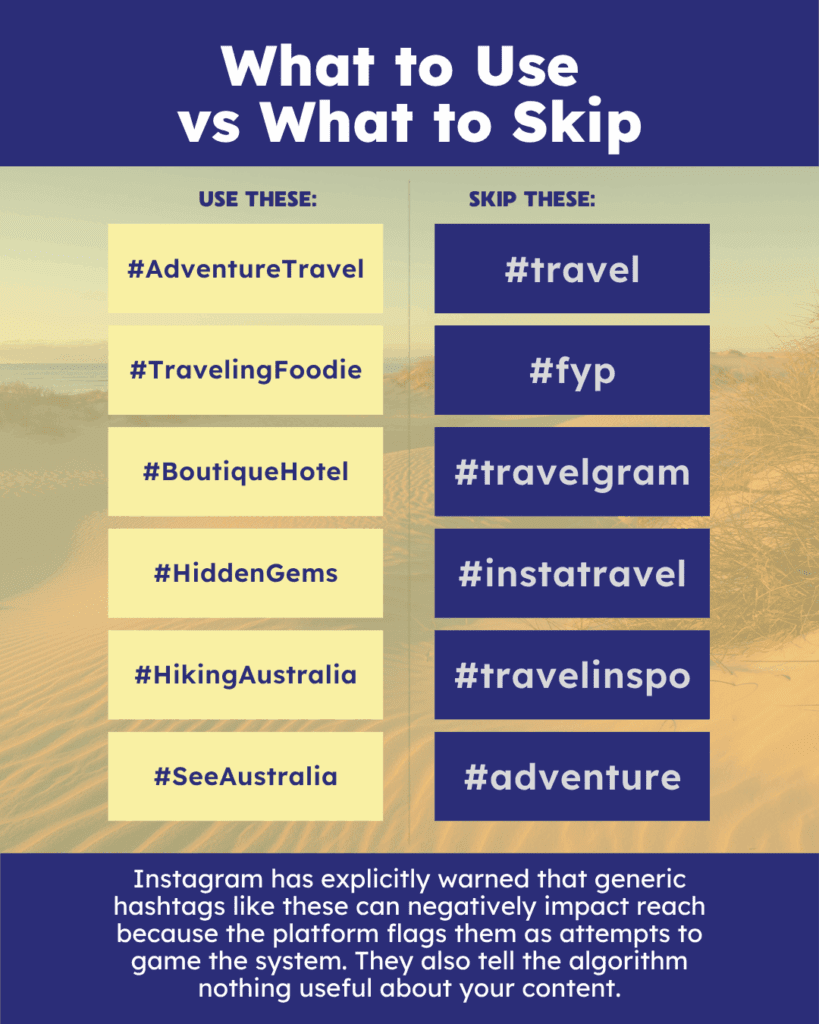
What to skip: #fyp, #viral, #explore, #reels. Instagram’s own advice is to use fewer, more targeted hashtags rather than many generic ones. They also tell the algorithm nothing useful about your content.
Niche hashtags: where your remaining slots go
Niche and community tags are where your content finds the right people. With five slots total, your remaining four should be doing targeted, specific work.
Our rule of thumb is tags with 10,000 to 500,000 posts: busy enough to be searched, small enough that you do not disappear into a flood of content. Go smaller for niche communities, larger only if your content is genuinely competitive.
Food and culinary travel
Adventure and nature travel
Luxury and boutique travel
Solo and independent travel
Road trip and slow travel
Australian tourism hashtags worth using
Tourism WA and Tourism Australia have built big audiences around their official tags. Post strong content and you are in with a chance of a reshare. One of these should almost always be in your five.
Tourism Western Australia
Tourism Australia
Hashtags for TikTok travel content
TikTok’s hashtag rules are different and the platform hasn’t imposed the same hard cap as Instagram. But the principle is the same: fewer, more specific tags outperform a flood of generic ones.
TikTok’s search function has grown significantly. Hashtags now work primarily as search and categorisation signals, helping the algorithm serve your content to the right viewer rather than broadcasting it broadly. Keep TikTok hashtags to 3 to 8, and prioritise ones that match how your audience actually searches.
- #traveltiktok: the main TikTok travel community
- #traveltok: strong engagement, especially for vlogs
- #travelreels: crossover audience from Instagram
- #travelvlog: 1.7M+ posts, active community
- #beautifuldestinations: 2M+ posts, high-quality travel content
- #traveltips: strong for educational or advice-led content
- #hiddengems: performs well for off-the-beaten-path destinations
- #airbnb: particularly relevant for accommodation content
Build your own branded hashtag
If you’re a tourism operator, venue, or destination, you need a branded hashtag that you use consistently and actively invite guests to use. With only five slots, a branded tag that collects guest content earns its place.
It does four things: builds a searchable content archive, generates genuine UGC, signals community activity to the algorithm, and compounds over time as more people use it.
Keep it short, memorable, and specific. Don’t create something so generic it gets swallowed by unrelated content.
💡 Working on a destination’s social presence?
Here’s how we approach content strategy for tourism brands.
The 2026 rules in plain language
Here’s the short version of everything above:
- Instagram has capped hashtags at 5 per post. Work within it, don’t fight it.
- Generic hashtags (#fyp, #viral, #explore) can actively hurt your reach. Drop them.
- Your caption now does SEO work. Write keyword-rich copy, not just emoji and vibes.
- Put hashtags in the caption, not the first comment. Instagram indexes them as a single package at time of posting.
- Niche tags (10k to 500k posts) outperform massive ones. Specific beats popular.
- One Australian tourism body tag should almost always be in your five.
- On TikTok, aim for 3 to 8 tags. Still fewer and more targeted than the old playbook.
- Audit your hashtag sets every quarter. Drop anything that’s consistently underperforming.
The quick-build formula for tourism brands
For tourism and hospitality brands creating short-form travel content in 2026, build your five like this:
- Slot 1, one broad travel tag: #travel or #travelreels
- Slot 2, one Australian or regional official tag: #WAtheDreamState or #exploreaustralia
- Slot 3, one destination tag: #margaretriver, #broome, #perthisok
- Slot 4, one niche experience tag: #foodtourism, #luxurytravel, #adventuretravel
- Slot 5, one community or branded tag with under 500k posts that fits exactly
Five slots. Every one earning its place. That’s the 2026 approach.
Keep reading
- For a deeper dive into WA-specific location tags, read our post on Perth and Western Australia hashtags for travel.
- Want to understand the commercial opportunity behind experience travel? Start with What is food tourism?
- Choosing between advocates, creators and paid talent? Read our influencer strategy guide.
From our work · #FoamRoam, Foam Coffee Bar144Instagram entries in three months