
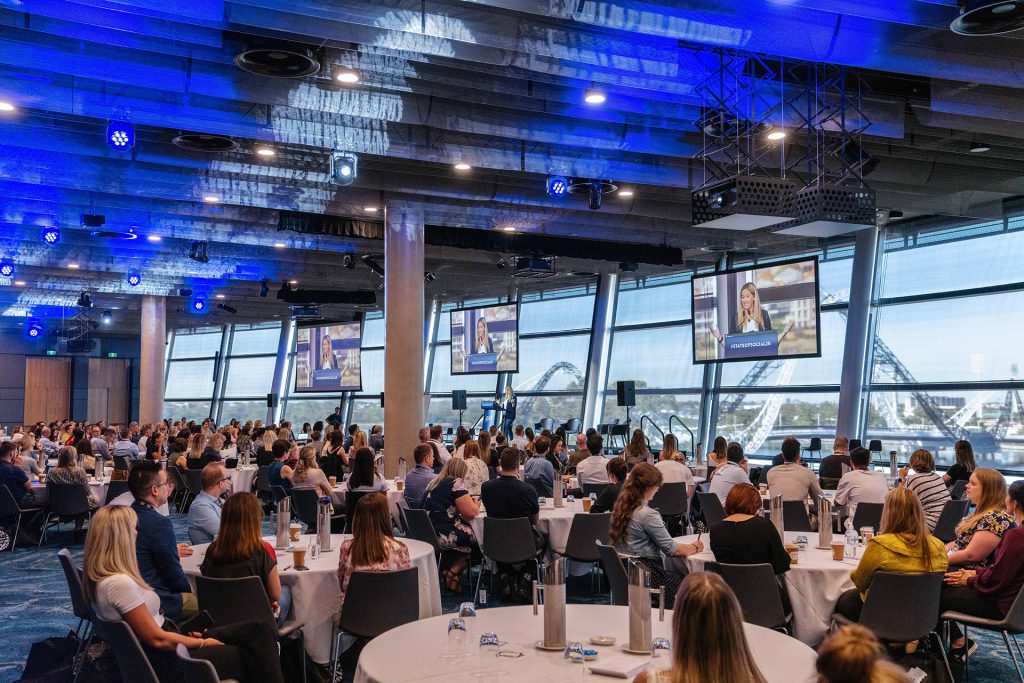
Most events don’t fail because of the lineup, the venue, or the catering. They fail because not enough people knew they existed, and even fewer cared enough to buy a ticket.
Social media is the engine that changes that. Not by blasting a Facebook event and hoping for the best, but by building a campaign with a proper arc: one that creates anticipation before the doors open, captures the energy on the day, and keeps the conversation going long after the last session ends.
Done right, your social media campaign doesn’t just sell tickets. It builds a community that comes back year after year.
We’ve been running social media for events in WA for over a decade, including State of Social, the digital marketing conference held in Perth every year. Here’s what actually works in 2026.
tldr; everything you need to know
Strategy first. Always.
Before you write a single caption or schedule a single post, you need a strategy. Not a content calendar. Not a Canva template. A strategy.
That means knowing the answers to these before anything goes live:
- What is the single most important outcome? (Ticket sales? Waitlist growth? Sponsor visibility?)
- Who is the audience, and which platforms do they actually use?
- What does success look like in numbers by event day?
- Who is responsible for what, and when?
Pick your platforms deliberately. In WA, Instagram and Facebook are doing the heavy lifting for most experience-led events. LinkedIn earns its place for conferences and industry events. TikTok is growing fast for younger audiences and festival formats. You don’t need all of them; you need the right ones, executed well.
For State of Social, we run a multi-platform approach that treats each channel differently: LinkedIn for credibility and professional FOMO, Instagram for atmosphere and excitement, Facebook for community and direct conversion. Each platform has a specific job.
Pre-event: build the machine before the day arrives
What you build in the months before decides what you have to work with on the day.
Build your content calendar
Map out every content moment from launch to pack-down. Announcements, ticket releases, speaker reveals, countdowns, behind-the-scenes. Know what’s going out, on which platform, in what format, and who’s making it happen. Content types that consistently perform in the pre-event phase:
- Speaker or lineup reveals (drip-fed to build anticipation, not dumped all at once)
- Behind-the-scenes setup or production content
- Short-form video teasers: Reels, TikToks, and YouTube Shorts
- Countdown posts with a direct link to purchase
- Social proof: testimonials and highlights from your previous event
- Early-bird and ticket-tier urgency posts
Make short-form video your pre-event engine
Short-form video is no longer a nice-to-have. Reels and TikToks are built to reach people who do not follow you yet: Instagram says most of what people see in Reels comes from accounts they do not follow.
- In Wyzowl’s survey, 85% of people said a video had convinced them to buy a product or service Wyzowl, 2026
- In 2025, TikTok’s average engagement rate by followers was 3.70%, against 0.48% on Instagram and 0.15% on Facebook Socialinsider, 2025 data
- Reels are reshared over 4.5 billion times a day Meta, Q4 2024 earnings call
For events, use short-form video to tease the experience: a speaker’s best quote from last year, a 10-second montage of crowd energy, a first-look at the venue. Keep it under 30 seconds, mobile-first, and caption it. Plenty of people scroll with the sound off.
Create your event hashtag and own it early
A good event hashtag tracks your coverage, gathers your crowd and helps new people find you. It should be short, specific, and impossible to misspell.
Use it on every piece of pre-event content. Put it on your email footers, your printed collateral, your email signatures. By the time your event opens, your audience should know the hashtag without being told.
For State of Social, the hashtag framework has been consistent across years (for example, #StateOfSocial24, #StateOfSocial25), making it easy to search historical content and new attendees to find the community.
Use retargeting to convert the warm audience
Paid social is not just for awareness. Retargeting people who have visited your event page but not purchased is one of the highest-ROI moves in your campaign.
Set up your Meta pixel or LinkedIn Insight Tag before your campaign launches. Build retargeting audiences from website visitors and video viewers. As ticket urgency increases, your retargeting messaging should shift: from ‘here’s what to expect’ to ‘only X spots left.’
Make it easy for people to share
Before the event opens, give your audience the tools to share on your behalf: a branded frame for their profile photo, a GIF set they can use in Stories, a shareable graphic for LinkedIn. The easier you make it, the more they’ll do it.
Live on the day: capture it all, share it selectively
On the day, most brands do one of two things. They post everything, or they get so busy that social stops.
Build a shot list, not a vibe plan
Work from your event run sheet and map out exactly what needs to be captured, when, where, and by whom. This isn’t about controlling every moment; it’s about making sure you don’t miss the non-negotiable ones.
For State of Social, we produce a detailed shot list before the event opens. Each platform gets specific content: LinkedIn gets depth and thought leadership; Instagram Stories get energy and immediacy; Reels get the moments that travel.
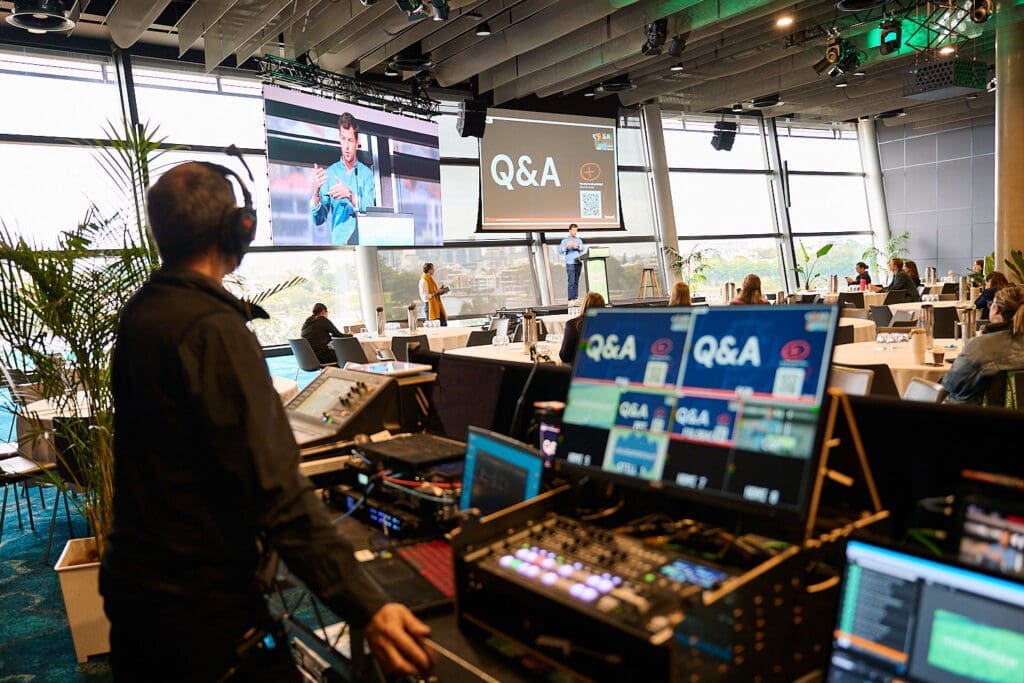
Platform-specific content on the day
Each platform gets a different job on the day:
- Instagram Stories: atmosphere, immediacy, polls and Q&As. Use countdowns for session starts. Post reactions as they happen.
- Instagram Reels: curated highlights from each day. Aim for at least one Reel per event day.
- LinkedIn: considered, text-forward posts with key insights from speakers. Photo albums at end of day with an editorial caption.
- Facebook: community tone, link sharing, longer captions that contextualise the action for those not there.
At State of Social ’21, our end-of-day LinkedIn photo albums delivered engagement rates of 53.4% and 74.29% respectively,. That’s not luck; that’s platform-specific thinking.
Fuel the FOMO, deliberately
Your live coverage should make two groups of people feel something: those who are there (proud they came) and those who are not (gutted they missed it). Every post should do at least one of those two things.
Share speaker insights as quote graphics. Post crowd reactions. Capture the moments between sessions. The informal, unchoreographed content often outperforms the polished stuff, because people trust it more.
Encourage UGC and engage with it in real time
Search your event hashtag during the event. Reshare the best attendee content. Reply to posts. Tag speakers when you quote them. The more you engage, the more others post.
User-generated content is your most credible social proof. Attendee content is proof you cannot fake, so every piece of it is an asset worth amplifying.
Post-event: don’t let the energy die
The moment your event ends, the campaign for the next one begins. The content you produce in the days after your event is the foundation of your 2027 campaign.
Share a surplus, but make it curated
You’ll have more content than you can post in one day, and that’s the point. A post-event content queue that runs for two to three weeks keeps the conversation alive and gives the algorithm more to work with.
Use this content to:
- Build FOMO for those who missed it (highlights, speaker moments, crowd reactions)
- Reward those who attended (behind-the-scenes, group shots, moments they might have missed)
- Tease next year (if dates or themes are known, start the conversation early)
- Repurpose long-form sessions into short Reels or quote tiles for extended reach
Send your post-event survey, fast
Send a post-event survey within 24 hours. The feedback you collect doesn’t just improve your next event; it tells you exactly what to put on social. If a particular speaker or session resonated, double down on that content. If something fell flat, don’t post it.
A good survey quote is some of the best content you will post all year. Short, specific, and from a real person. Screenshot it, caption it, post it.
Nurture the community you just built
Every event grows your social following and your mailing list, if you’ve made it easy to join both during the event itself. QR codes linking directly to email sign-up, a follow prompt in your event app or run sheet, a clear CTA in your post-event email: all of these compound over time.
The audience you build at one event is the warm audience for the next. Don’t go quiet. Keep them engaged with regular content through the year, then ramp back up when the campaign cycle restarts.
Measure what matters (not just what’s easy)
Social media metrics are only useful if they connect back to your actual event goals. Reach and impressions tell you how many people saw your content. Clicks, conversions, and ticket sales tell you whether it worked.
- When Cvent asked planners which KPIs they use most, the top answers were attendee engagement (34%), event feedback (34%) and attendance (31%) Cvent Planner Sourcing Report, 2026
- 41% of US event marketers struggled to measure ROI and create competitive events in 2024 Splash, 2025 Outlook on Events
The metrics worth tracking for an event social media campaign:
- Reach and impressions (how far did the campaign travel?)
- Engagement rate by platform and post type (what content resonated?)
- Link clicks and ticket conversion rate from social (what converted?)
- Hashtag volume and sentiment (how did the community respond?)
- Follower growth across the campaign period (what did we build?)
- Post-event content performance (what extended the hype?)
Record everything. Your post-campaign report is your strategy brief for next year.
From our work · State of Social 2021Nearly 500marketers at Optus Stadium, the biggest year to that point