

You can’t ignore SEO for tourism
In tourism, everyone is chasing the same few spots on page one.
If you want more bookings, more sales or more traffic, you need search engine optimisation.
tldr; everything you need to know
First, what SEO is. Then what to do about it.
What is SEO?
Search engine optimisation (SEO) is the work that gets your website found in search results, and gets the right people clicking through to it.
The idea is simple: the closer you are to the top, the more people see you. The top organic result on Google gets the biggest share of clicks.
Search engines are driven by a mission to provide the best and most relevant content to search users. Consequently, if your website houses valuable and engaging content that assists users in finding what they seek, it stands a strong chance of ranking near the top of the first search page.
In particular, Google encapsulates its mission: “To organise the world’s information and make it universally accessible and useful.”
Simple to say, hard to do. Great content gives you a head start. Keeping it means working on your site all the time, with the guest’s experience first.
Why is SEO for tourism important?
For all industries, SEO is important. However, in the tourism industry, it’s essential. Whether it’s a weekend away or an overseas trip, people don’t want to waste their money on disappointing experiences.
Where do you think they head first before want-away travellers even think about heading off? Yep, Google.
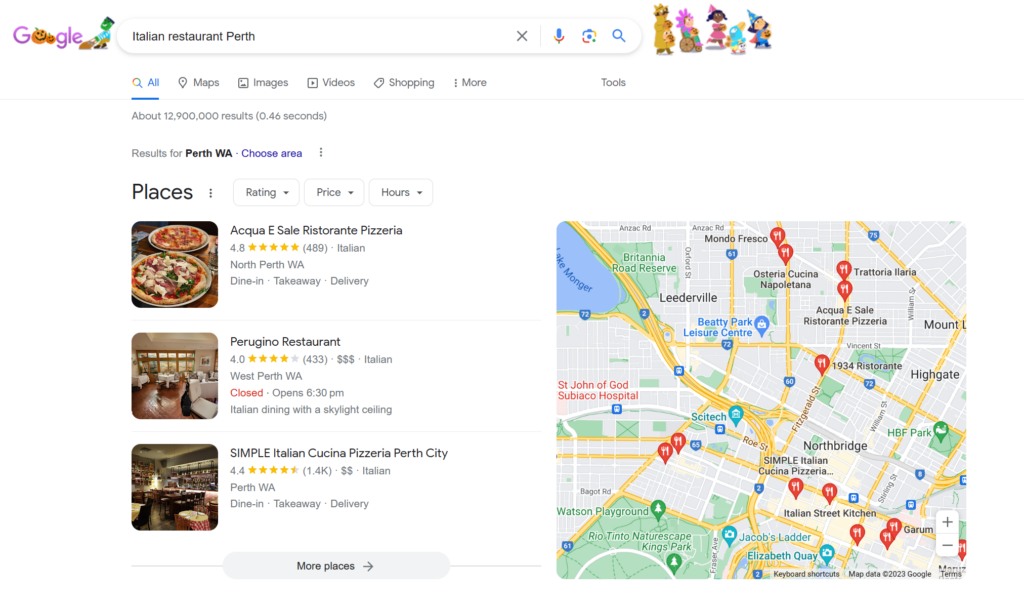
Search engines play a vital role in our lives, whether it’s to look for a new restaurant or cafe or to help us plan our next holiday. Ensuring your business can be found online when people are looking is essential.
So, that’s all fair enough, but how can you implement SEO for your tourism or hospitality brand?
SEO tips for tourism and hospitality brands
SEO can be broken into two main parts: onsite and offsite SEO. Onsite has everything to do with your website, the content it holds, and how it works and functions. At the same time, offsite SEO is more about other websites that mention and link to you. Think of offsite SEO as your online PR.
Onsite optimisation
Your website represents your business online. For some people, this may be the only version of your business/brand they experience. Therefore, long story short, you want to make it the best.
This includes:
- Having valuable and exciting content that your target audience will be interested in
- Ensuring it can be used easily across desktops, mobiles and tablets.
- Make sure it loads fast. We are impatient creatures, and when a web page takes more than three seconds to load, many people hit that back button.
- Common sense: you don’t want people to land on broken web pages or be unable to find your contact details. Make sure you look at your website in the eyes of a customer.
- Making your website search-engine friendly is to balance what people love and tick the boxes of what Google loves. Most of Google’s recommendations are relatively common sense, yet your website can lag if your developer is unaware of SEO best practices.
- Optimise images: compressing images, optimising file names and adding alt text can go a long way to nailing your SEO.
Our best advice is to head over to Google’s SEO Starter Guide to ensure your website ticks all these essential SEO-friendly boxes.
Once your website functions well, you can move on to your offsite optimisation.
Offsite optimisation
The more mentions you get online from other websites, the more ‘popular’ you will look in Google’s eyes. Whenever someone mentions your brand online, it creates more touchpoints for people to find you. It’s just like getting good press in the real world. The more people talk positively about your brand, the more you will shine on the search result pages.
Besides naturally getting good press and people wanting to mention your brand, how can you help boost your offsite SEO?
Here are a few tips:
- Ensure you are listed in relevant online business directories.
- Respond to media callouts to be quoted in articles or contribute a guest post to another website (a great media callout to keep an eye on is SourceBottle).
- Create fantastic content that people will want to link back to.
When looking for ‘backlinks’, as the SEO industry calls them, you want to ensure you’re obtaining them for SEO value because your target audience may be visiting them. Great backlinks will not only help you rank higher in Google, but they should also send relevant referral traffic to your website.
To see the traffic coming to your website from other websites, make sure you have Google Analytics set up. You can look at the Referrals Acquisition report when it is set up. In this report, you’ll see how many people click through from these websites. Plus, if you have goal conversion tracking set up in Google Analytics (which you should!), you’ll also see if any of these visitors trigger those key actions you want people to take on your website.
Google Business Profile
If you do one thing after reading this, set up your Google Business Profile (it used to be Google My Business) and keep it current.
Google Business Profiles are prominently displayed on search result pages and Google Maps, acting as a virtual shopfront that conveys essential information about your brand. Additionally, customers can leave reviews on this platform, which can significantly impact your reputation.
Creating a Google Business Profile is a simple and cost-free process. Once your profile is verified, you gain the ability to:
- Upload photos and videos showcasing your business.
- Display contact information and operating hours, including holiday hours.
- Encourage customers to leave reviews.
- Publish posts to promote news, blog posts, special offers, events, and products.
- Respond to inquiries and comments from visitors.
- Enable messaging for direct communication with potential customers through the listing.
These listings typically appear when people search for your brand name or related products and services within your vicinity. Like most SEO tasks, setting up and maintaining your Google Business Profile requires time and attention.
Do it yourself or hire a specialist, but start now, and measure what it does. Google Analytics, a free tool, is invaluable for tracking website traffic and evaluating whether users are taking the desired actions on your site.
Do I need a physical location to have a Google Business Profile?
Only trade online? You can still set up a Google Business Profile.
Want to know where your site stands in search? Send us the link and we will point out the three fixes worth making first.